Cheapest seatNo landing
18 min18-Minute Twin Glacier
- 18 minutes, over Franz Josef and Fox Glaciers
- Helicopter flight
- Mobile voucher accepted
- Free cancellation
$232
Check availability→ 
Compare Franz Josef helicopter tours to see the glacier from above. We compared 8 flights, prices start at $232, free cancellation is included, and the top 25-Minute Alpine Landing scores 4.8 from 693 reviews. Ice pinnacles and crevasses fill the Southern Alps views.
From, per person
7 flights compared$232
Today's lowest price across all 8 flights
Average rating
6 rated flights48
1,705 verified reviews across 6 flights
Time in the air
Shortest to longest18–50min
Shortest: Twin Glacier
Longest: Shackleton
Every flight from the village
Everything that flies out of Franz Josef, in one place: seven options between $232 and $911, all with the same aircraft type and the same weather rules. The short flights differ mainly in how much of the Southern Alps you cross before the skids touch snow. The heli-hikes are a different thing entirely — you get off the machine and walk into the ice.
★ 4.8 · 693 reviews
★ 4.8 · 84 reviews
★ 4.9 · 527 reviews
★ 5.0 · 2 reviews
★ 4.8 · 398 reviews
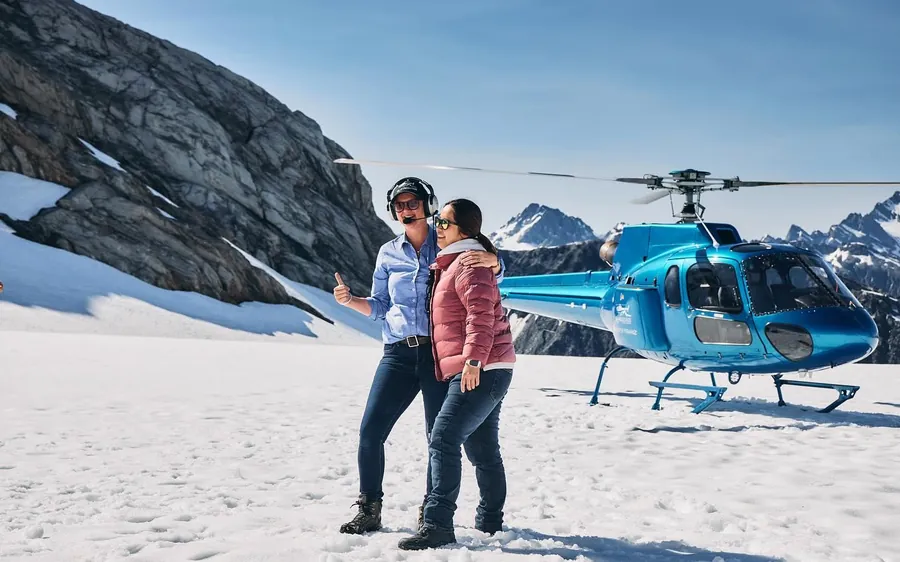
★ 5.0 · 1 reviews
Two questions
Seen the seven above and still torn? They are not versions of each other. Eighteen minutes shows you the ice; twenty-five puts you on it; a heli-hike gives you the day. Pick what matters most and we will point at one.
See it before you pay for it
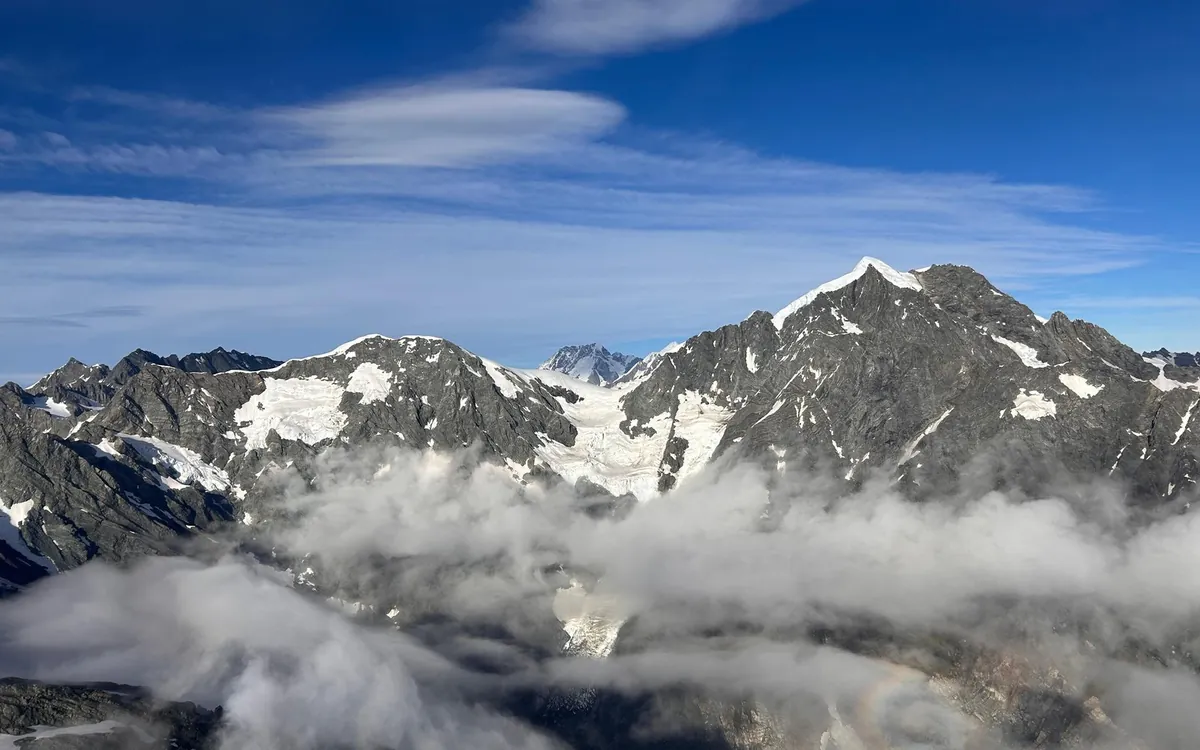
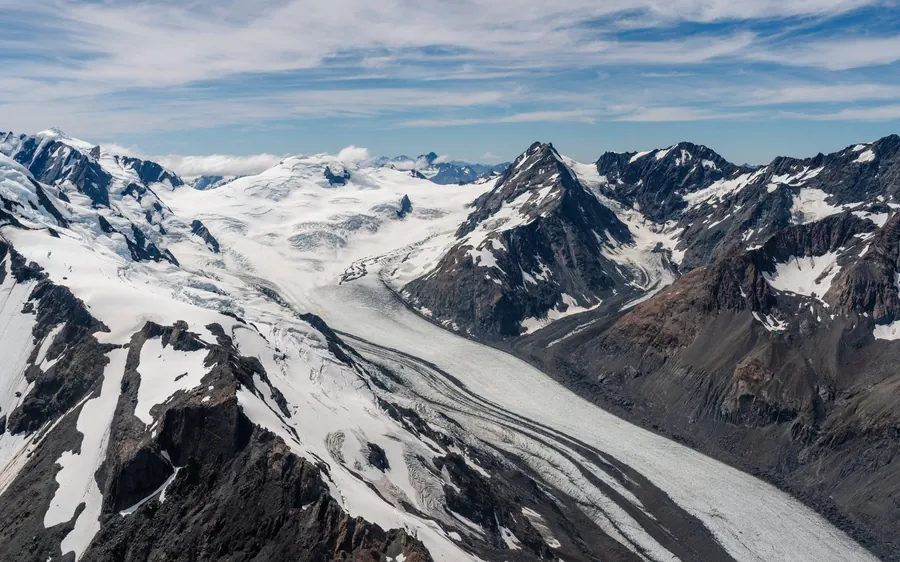
The pad is in the village, so the rainforest is under you within seconds. Then the valley narrows, the grey of the moraine gives way to blue, and Franz Josef Glacier appears as a broken staircase of ice falling out of the mountains. The pilot climbs along it. Higher up, the crevasse field flattens into the névé — a white bowl that feeds the whole glacier — and that is where you land. On the longer flights you cross the divide to Fox or Tasman and come back past Aoraki / Mount Cook.
Side by side
The three short flights cost within sixty dollars of each other, and the difference is not really the duration — it is whether you land, and how much of the Alps you see before you do.
Swipe the table sideways →
| 18-Minute Twin Glacier | TOP PICK25-Minute Alpine Landing | 35-Minute Two Glaciers | |
|---|---|---|---|
| Price per person | $232 | $232 | $291 |
| Time in the air | 18 min | 25 min | 35 min |
| Cost per minute | $12.89 | $9.28 | $8.31 |
| Lands on the glacier | No | Yes, alpine landing | Yes, ten minutes |
| Franz Josef | Yes | Yes | Yes |
| Fox or Tasman | Fox | No | Fox or Tasman |
| Aoraki / Mount Cook | No | Part of the range | Yes |
| Rating | New | 4.8 · 693 | 4.9 · 527 |
| Best for | The tightest budget | Most visitors | Two glaciers in one flight |
| Check dates | Book this one→ | Check dates |
Free cancellation up to 24 h · No booking fee
Verdict
The twenty-five-minute flight is the shortest one that still lands on the snow, and that is the whole decision. The eighteen-minute flight costs the same and stays in the air, so you fly all the way to the West Coast and look at the glacier through a window. The extra $59 for thirty-five minutes buys a second glacier and a pass by Aoraki / Mount Cook.
Check dates and availability→Before you book
Nobody sets down on the icefall itself. Flights climb alongside it and land higher up on the névé, the snowfield that feeds the glacier, where the surface is stable enough to take the skids. That is why the landing photographs show smooth snow rather than the broken ice you flew over a minute earlier.
Two-minute check
Three things decide it here: how much of the day you have, whether you want to stand on the ice, and what the budget stretches to. Answer three questions and find out before you pay.
How many mornings do you have here?The weather decides, not you
Can you walk on ice for two hours?Only the heli-hikes need this
What do you actually want?This is the whole decision
You’ll get the one that fits your answers, and the thing about it that catches people out.
Six ways to see it
These are the operators' own numbers on GetYourGuide, not ours — we do not collect reviews and we do not rewrite anyone else's. Two flights carry almost all of them, which tells you what people actually book.
★★★★★
Based on 1,705
verified reviews
All seven Franz Josef flights and heli-hikes, rated on GetYourGuide.
Read all 1,705→25-Minute Alpine Landing
From $232 · lands on the snow
★★★★★
Twenty-five minutes over the icefall and ten on the névé. The cheapest flight that lands, the one most people here book, and the one reviewers almost never regret.
Heli-hike, 2.5 hours on the ice
From $529 · guided, with crampons
★★★★★
Flown in, fitted with boots and crampons, and walked through the crevasse field for two and a half hours. Since the valley track was cut back there is no alternative to it.
The valley walk
Free · about 90 minutes return
★★★★★
A flat marked track up the riverbed to a viewpoint, past markers showing where the ice stood decade by decade. It shows you the scale of the retreat in a way no flight does. It also stops several hundred metres short of the ice.
Franz Josef: Franz Josef Glacier Lookout Guided Walk
From $65 · guided
★★★★☆
The same track with a guide reading the terminal moraine, the markers and the rock for you. Rated 4.8 across 169 reviews. It is the best value on this page and it still does not reach the ice.
Small group · guided
18-Minute Twin Glacier
From $232 · no landing
★★★☆☆
Eighteen minutes over Franz Josef and Fox, which is genuinely good, and then back to the village. It costs the same as the flight that lands on the snow, which is why it loses stars here rather than for anything it does wrong.
Franz Josef: Waiho Hot Tubs 1 Hour Private Experience
From $79 · 1 hour
★★★★☆
Private hot tubs in the rainforest at the edge of the village. It has nothing to do with the glacier and it is the thing people book when the cloud comes down and the flight is called off.
Booked alongside the flight
What it really costs
Four operators fly from Franz Josef and each publishes one seat price, charged the same everywhere — their own desk, the booking platforms, the hotel in the village. What changes is whether there is a seat left on a day the weather is good, and in this valley that is the whole game.
Swipe sideways →
| Where you book | Price | Risk | Cancellation |
|---|---|---|---|
| Online in advance | $232–$911 | None — your seat is held | Free up to 24 hours |
| At the desk in the village | Same price, no discount | Only what is unsold that day | Desk policy, usually stricter |
| Waiting for better weather | Same price | High — everyone rebooks onto the first clear day | None once boarded |
The honest answer
Two hundred and thirty dollars for twenty-five minutes is a lot of money, and we are not going to pretend otherwise. What you are buying is access: the walking track was closed to the ice years ago, and the glacier you came to see starts where the track stops.
The flight, minute by minute
Everyone is weighed. Seats are assigned by balance, not by who booked first.
Two minutes on the door handles, the seatbelt and the rule about never walking uphill of the machine.
The pad sits in the village. Podocarp forest is under the skids within seconds, and the Waiho riverbed opens ahead.
The grey moraine gives out and the ice begins — the part visitors used to walk to, seen from directly above.
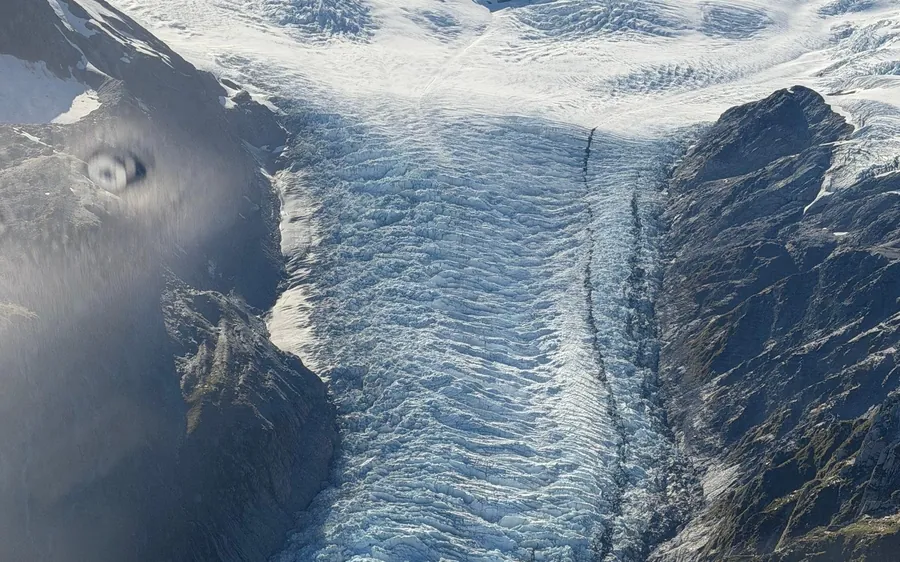
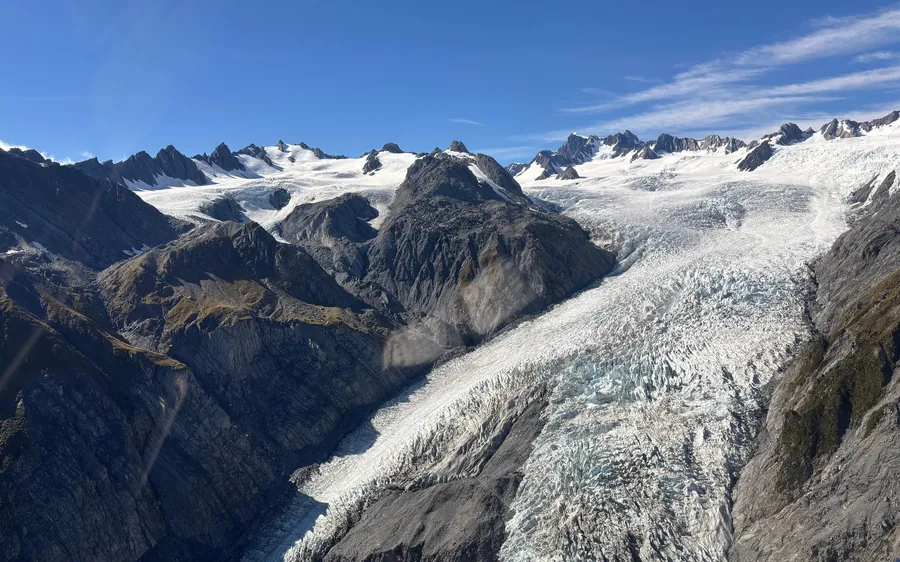
The glacier breaks into seracs and crevasses as it falls out of the mountains. This is the section no walk can reach.
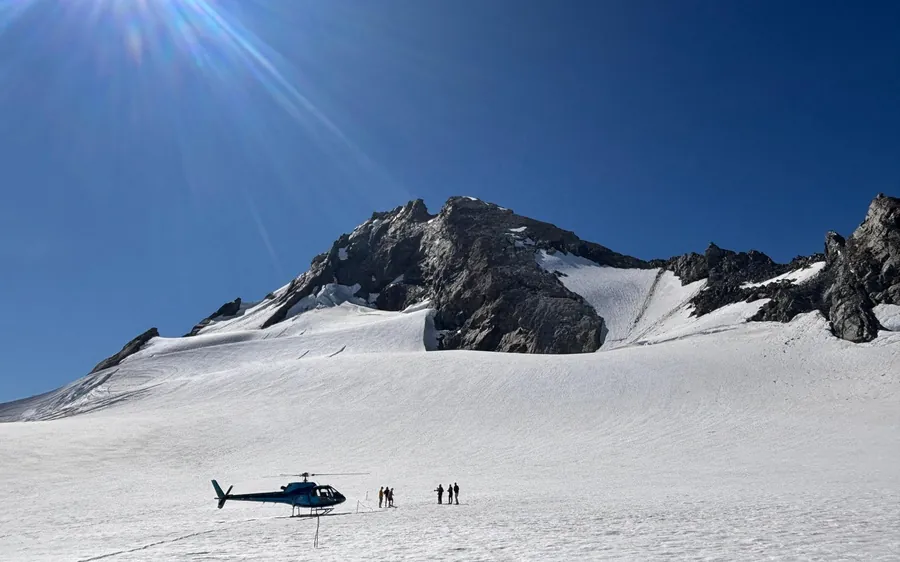
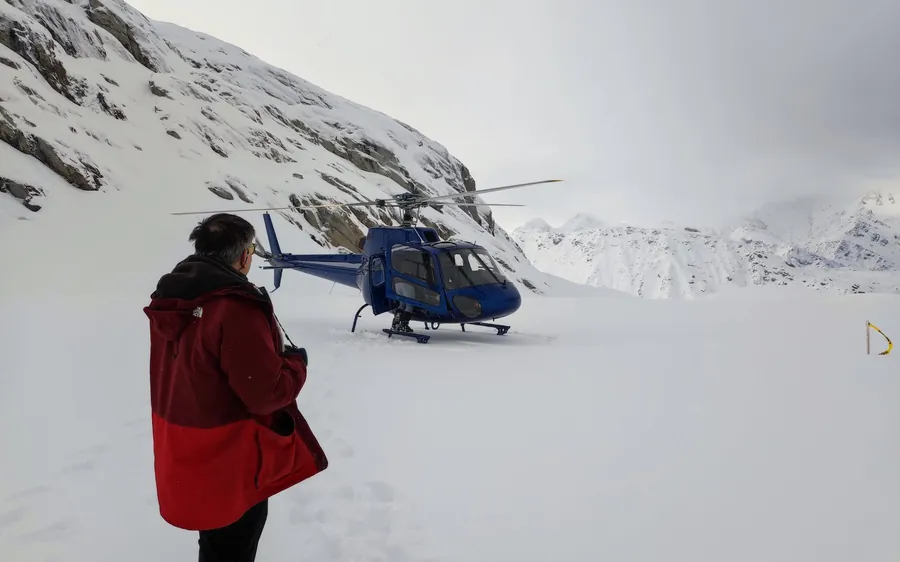
The skids settle on the snowfield that feeds the whole glacier. Ten minutes outside, silence, and the Alps in every direction.
On the longer flights the pilot crosses to Fox or Tasman and returns past Aoraki / Mount Cook.
Best time of day
Cloud on the West Coast builds as the valley warms, and by early afternoon the tops are often in it. The first flights of the day are cancelled least often and fly in the smoothest air. If the morning goes bad you still have the rest of the day to be rebooked into — book the other way round and you have nothing.
On the route
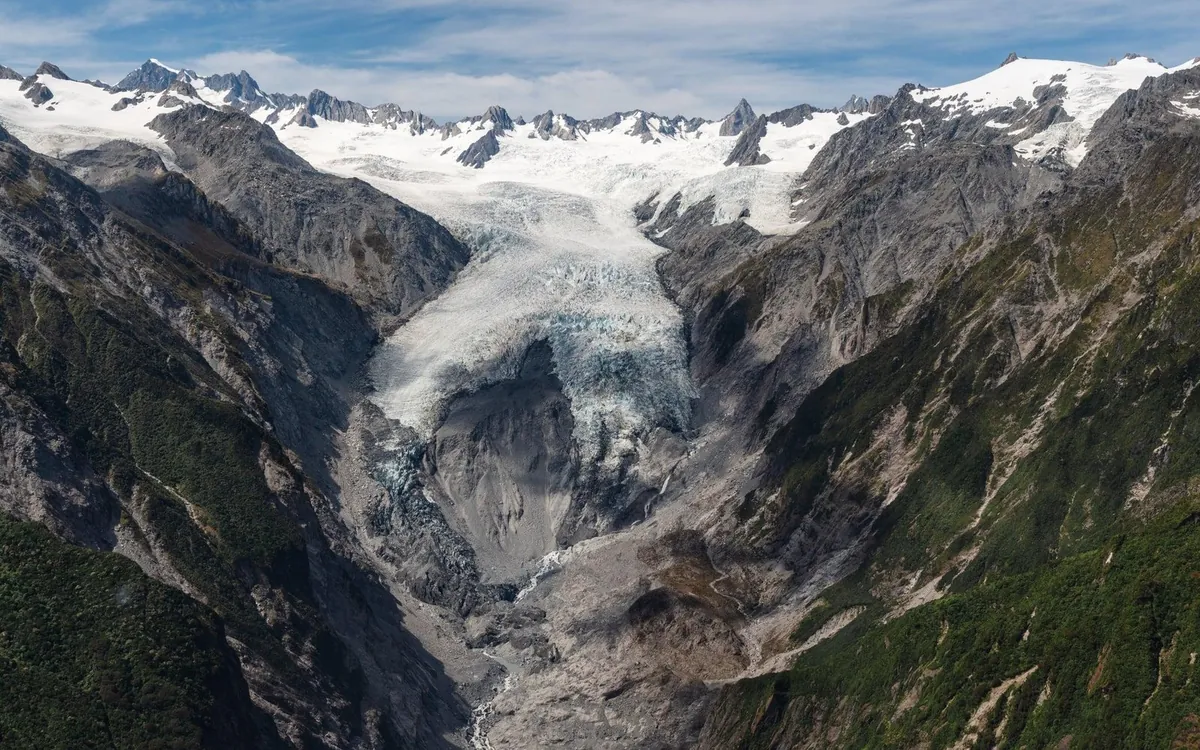
Seracs and crevasses where the glacier falls out of the mountains. No walking track reaches this.
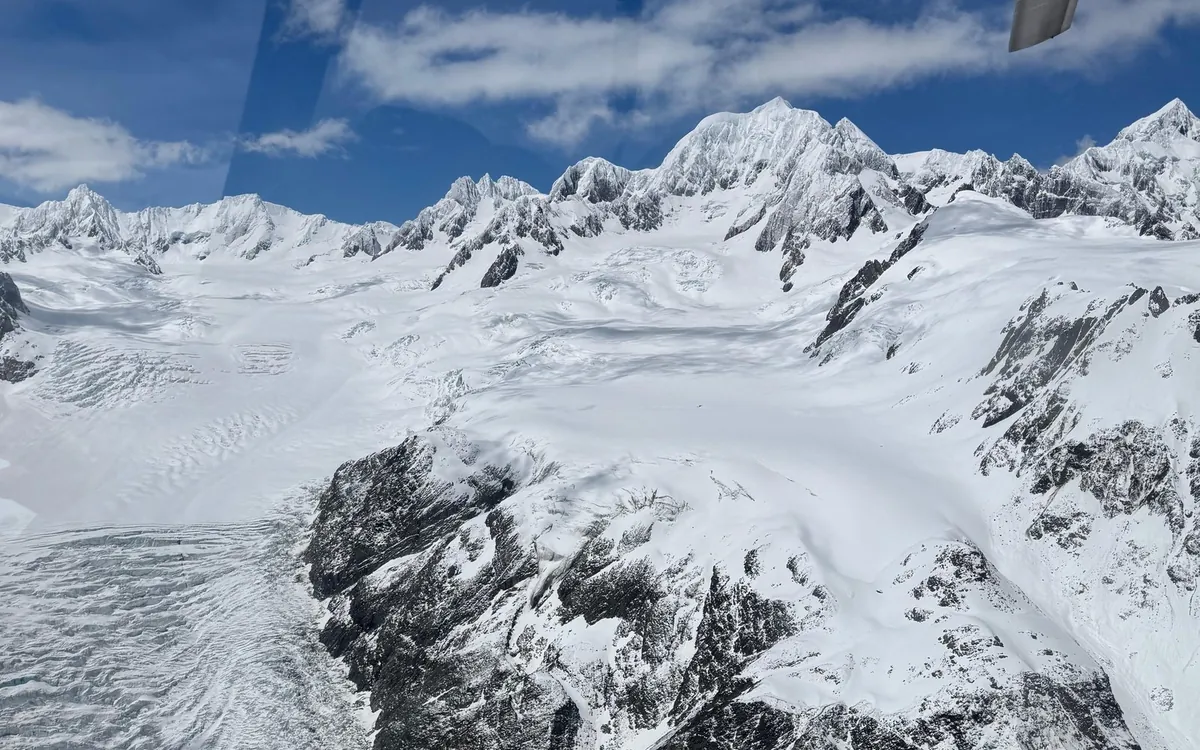
Compressed ice reads blue from the air, in bands you cannot see from the valley floor.
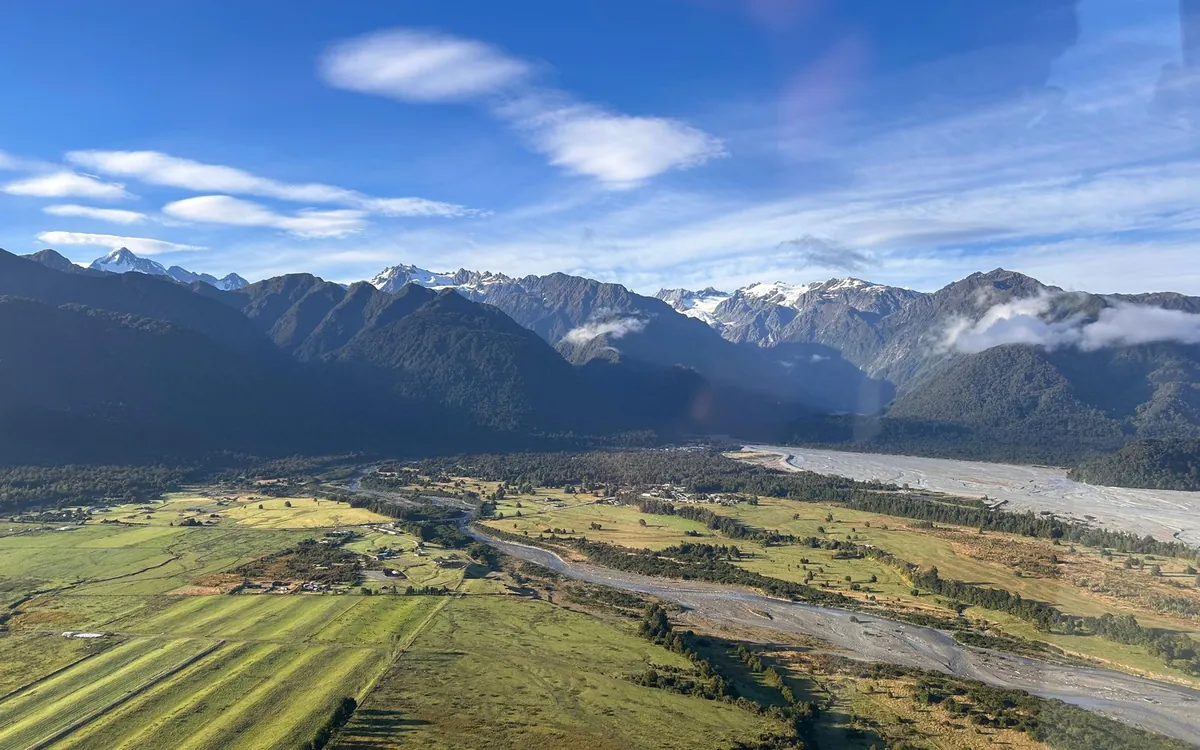
One of the few places on earth where a glacier ends this close to temperate rainforest.
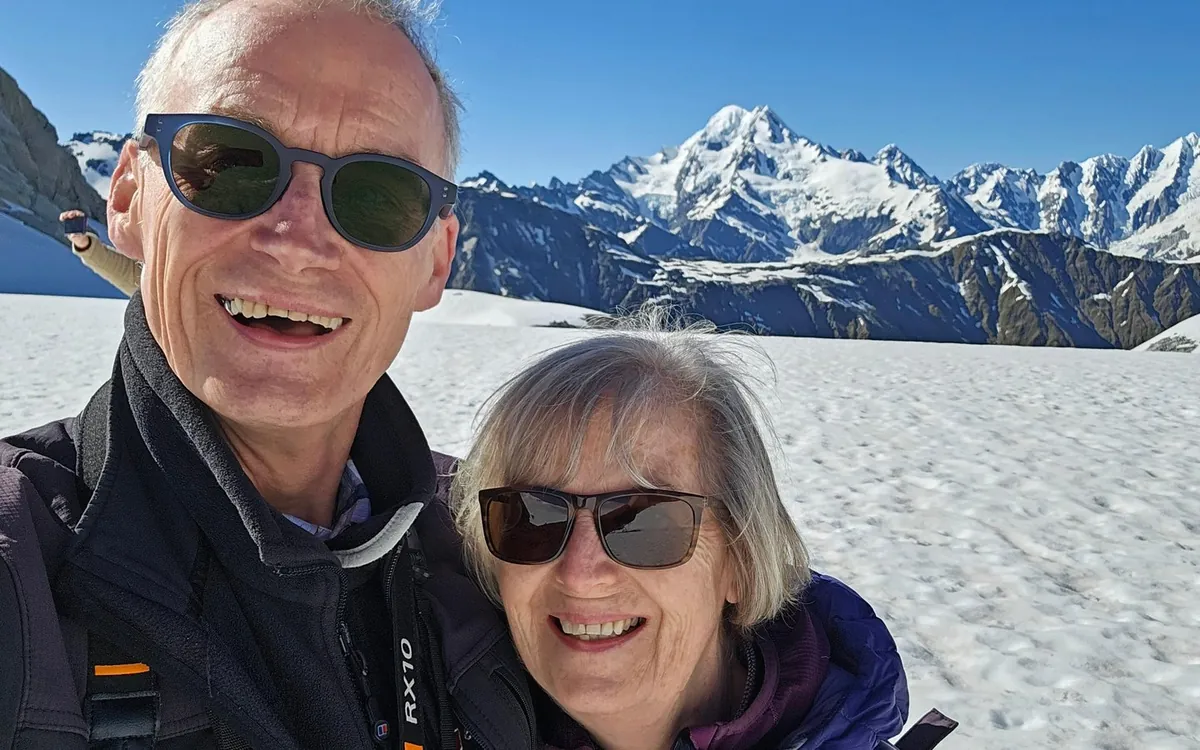
The landing is short. It is also the part everybody talks about afterwards.
What it's like
The part nobody warns you about is how quickly it stops being a village. The pad is a strip of gravel behind the main street, and thirty seconds after the skids leave it the shops are gone and you are over podocarp forest so dense it reads as a single green surface.
The Waiho riverbed opens first — a wide grey braid of meltwater and shingle that looks far too big for the stream running down the middle of it. That is the first honest piece of information the flight gives you: the glacier used to end down there.
Then the valley narrows and tilts up, and the ice appears. Not the postcard view from the car park a kilometre back, but the terminal face from directly overhead, grey with rock flour and split across the front. It is the part visitors used to walk to. The track to it has been closed for years, and from up here you can see exactly why: the face is collapsing into its own valley.
Above it the glacier becomes something else entirely. The icefall is where Franz Josef drops out of the Southern Alps in a staircase of seracs the size of houses, blue where the ice is old and compressed, white where it has broken recently. There is no route through it on foot. This is the section the helicopter exists to show you, and it lasts about ninety seconds.
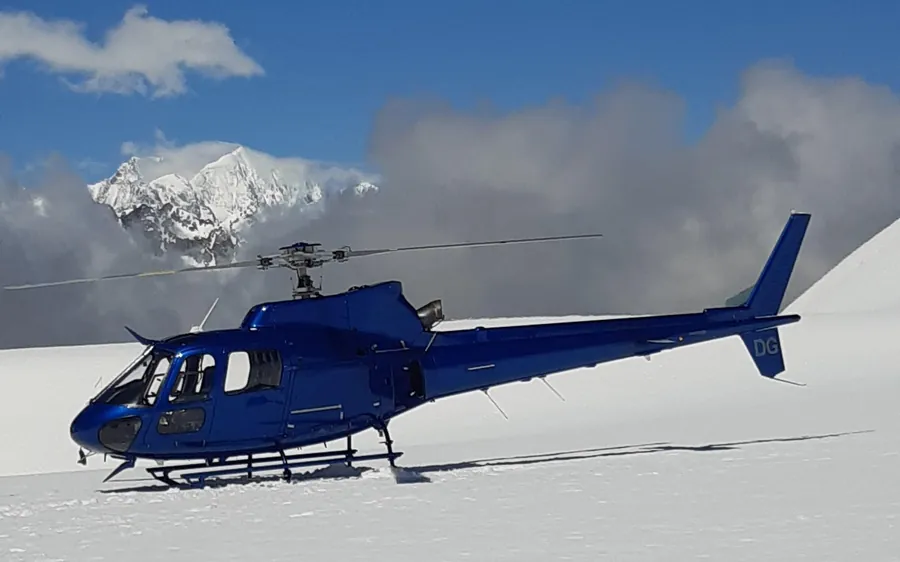
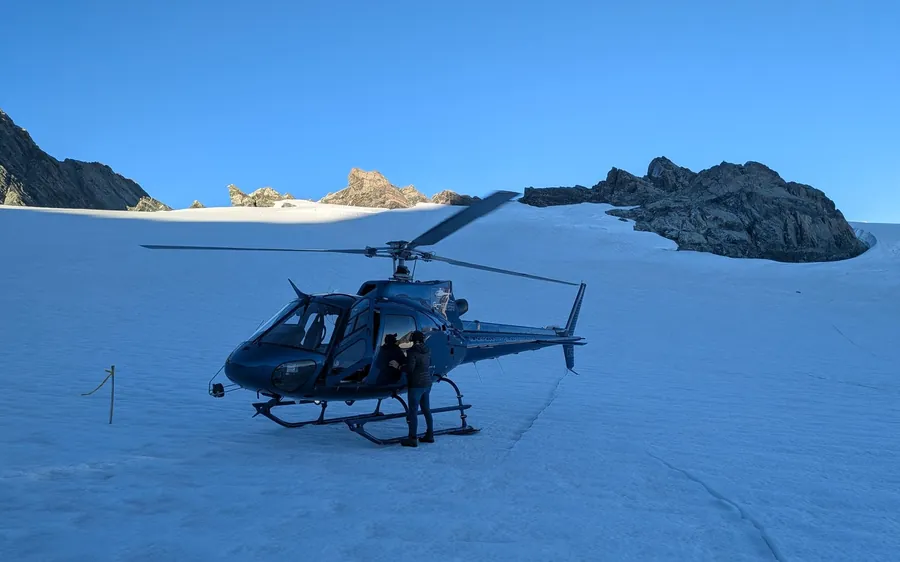
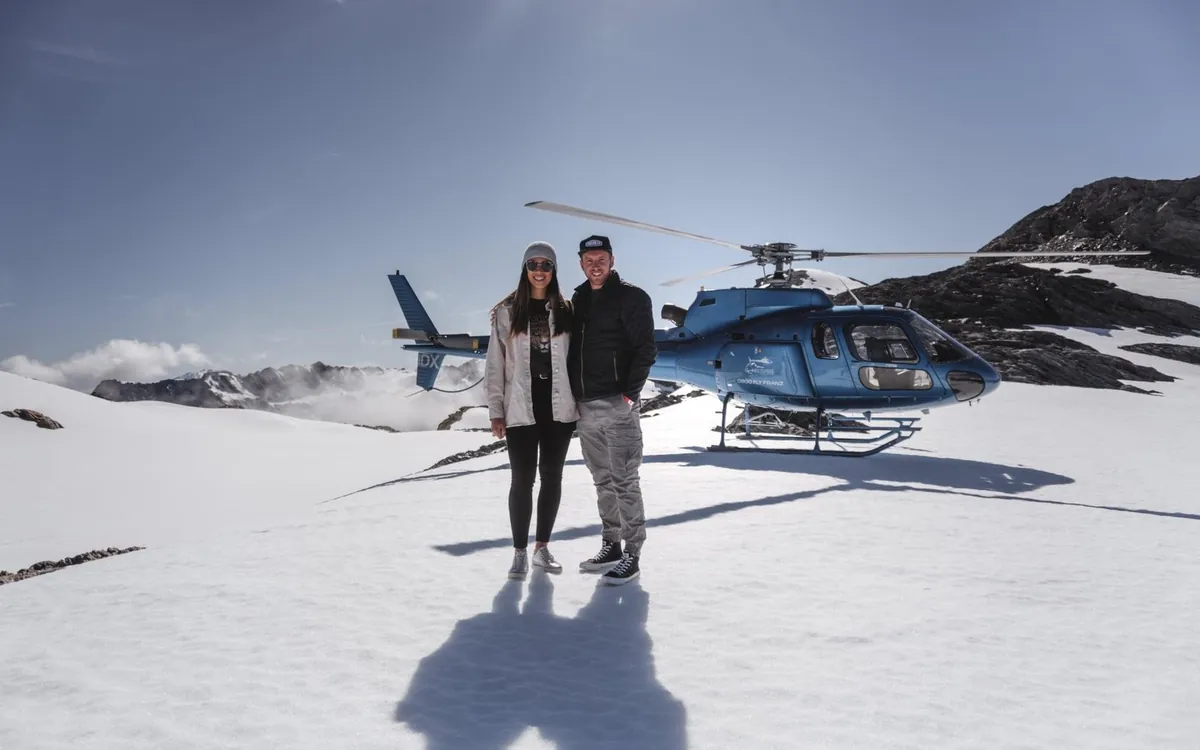
Then the ground flattens. The crevasse field opens out into the névé, a white bowl of snow that feeds everything below it, and the pilot picks a spot and sets down. The engine winds back, the doors open, and the noise stops in a way that is genuinely startling. Ten minutes, boots in packed snow, the Alps standing all the way round the horizon and the Tasman Sea a grey line to the west.
On the longer flights the return is the second half of the show. The machine crosses the divide to Fox, twenty-five kilometres south and a longer, straighter river of ice, or swings inland over Tasman with Aoraki / Mount Cook off the right-hand side. Then the nose drops, the snow gives way to rock and the rock to forest, and you are back over the riverbed with the village ahead.
It costs more than most things you will do in New Zealand. What you are actually buying is the twenty minutes between the terminal face and the névé, and there is no other way to buy them.
While you're in the village
The flight takes about an hour. Franz Josef is a long way from anywhere, so most people are here for two nights and need something for the afternoon the weather takes.
3 hours · ★ 4.8 (169)
$65See dates 1 hour · ★ 5 (1)
$79See dates 6.5 hours · ★ 4.8 (28)
$1058See datesBefore you book
Franz Josef gets about five metres of rain a year. Flights cancel often, and the people who fly are the ones who left themselves a second morning.
Franz Josef village sits where wet westerlies meet the Alps. Rain is the normal state, not the exception.
Flights go in light rain and stop when the cloud sits below the tops. A grey morning is not automatically a cancelled one.
Air is calmest before the valley heats up. The first slot of the day is cancelled least often.
If the operator cancels you get the money back. Getting another seat that week is your problem.
Book the first morning of two nights, not the only morning of one.
Operators call or message the evening before with a realistic read on the morning.
The landing site is near two thousand metres. It can be twenty degrees colder than the village.
You step onto packed snow. Sandals and thin trainers make the ten minutes miserable.
The cabin is warm in sun and the outside is not. One jacket solves it.
Snow glare at altitude is severe, and there is no shade on the névé.
Boots, crampons, jacket and overtrousers come with the guided walks.
Cabins are small and weight matters. A camera and a jacket is the sensible load.
Everyone is weighed at check-in and the pilot balances the machine. Nobody chooses a window.
Operators publish one seat fare and hold it everywhere. There is no cheaper channel.
Every flight on this page can be cancelled the day before at no cost.
Peak season fills the first morning slots weeks out.
You are walking on ice for two hours or more. The operators are explicit about this.
Age limits differ by operator and by flight; the listing states each one.
Over Arthur’s Pass and down the coast. Not a day trip.
Via Haast Pass, one of the finest drives in the country.
The straightforward run down State Highway 6.
All operators fly from the edge of the township. No airport transfer.
Some flights leave from there instead; check which village your booking names.
Fill up in Hokitika or Haast. The village has a few places and they close early.
Best time
The glacier flies all year. What changes is how many days in a row are flyable, and how far ahead the good slots are gone.
Feb – Apr
The most stable air of the year. Long enough days for an afternoon slot and the smallest chance of losing your only morning to cloud.
Dec – Jan
Peak season on the West Coast. Good flying, but the first slots go weeks ahead and the village is full.
May – Aug
Winter brings the sharpest air and the emptiest pad, along with short days and long spells of rain between them.
Sep – Nov
Fresh snow high up and a green valley below, but the weather changes hour to hour. Leave two mornings free.
Worth knowing
Book the first slot of the morning. Air is smoothest before the valley warms up, and if the morning goes bad you still have the afternoon to rebook.
Two nights, not one. Half the people who miss out had a single morning here. The weather does not care about your itinerary.
The eighteen-minute flight does not land. It costs the same as the twenty-five-minute flight that does.
Wear closed shoes. You will be standing on packed snow at altitude. This catches people out more than the cold does.
Do not walk uphill of the helicopter. The rotor disc drops on sloping ground. The briefing covers it; people forget it anyway.
Ask which glaciers your flight crosses. “Two glaciers” can mean Franz Josef and Fox, or Franz Josef and Tasman.
Round out the trip
Go deeper
Common questions
Seats run from $232 for the eighteen-minute flight and the twenty-five-minute alpine landing, through $235 and $291 for the thirty and thirty-five minute flights, to $529 for a guided heli-hike and $911 for the full-day version with lunch. Those are per person and they are the same at every desk in the village.
Not onto the ice. The valley track was cut back after the terminal face retreated and became unstable, and it now ends at a viewpoint well short of the glacier. Guided access to the ice itself is by helicopter only, which is why the heli-hike exists as a product at all.
A scenic flight puts you over the glacier and, on most options, down on the snowfield above it for ten minutes. A heli-hike flies you onto the ice, hands you boots and crampons, and a guide walks you through the crevasse field for two and a half hours or more before flying you out.
No. The eighteen-minute flight stays in the air. The twenty-five, thirty and thirty-five minute flights all include a landing on the snow, usually ten minutes. If the landing is the reason you are booking, read the duration line before you pay.
Often enough that it should change how you plan. This is one of the wettest inhabited places in New Zealand. Operators fly when the cloud base is above the tops, refund you when it is not, and cannot promise you a seat the next day. Book the first morning of a two-night stay.
They are twenty-five kilometres apart and most flights from Franz Josef cross both. Franz Josef has the steeper icefall and the bigger operation; Fox is quieter and the valley is longer. For a base, Franz Josef has more beds and more aircraft, which matters when the weather compresses everyone into one clear morning.
The road viewpoint shows you the valley and the end of the ice from about a kilometre away. The flight shows you the icefall, the crevasse field and the névé, and puts you on top of them. They are not the same view of the same thing.
Free · no account needed
One PDF with the schedule that works around the weather, the flying window and the drive either side. Built from the same sources as this page.
The plan is on its way. If it isn't there in a minute, look in Promotions.
Why trust this page
Every price, duration and rating was read off the live listing, and is re-checked each quarter.
We list every helicopter flight and heli-hike sold at Franz Josef, not a shortlist. Nobody pays to be featured.
This page exists to answer one question: which flight to book. If a section did not help with that, we cut it.
Glacier and access information comes from the Department of Conservation and the operators' own briefing material.
The answer
The cheapest flight that puts you on the ice, and the one most people here book. The eighteen-minute option costs the same and never lands; the thirty-five-minute flight adds a second glacier and Aoraki / Mount Cook.
Check dates and availability→ Free cancellation up to 24 hours · Reserve now, pay laterBefore you go
The Franz Josef schedule built around the weather and the flying window, plus what to do with the afternoon the cloud takes.
Check your inbox in a minute.
or
Just show me live dates and prices → 25-Minute Alpine Landing
★ 4.8 · 693 reviews · Free cancellation 24 h